
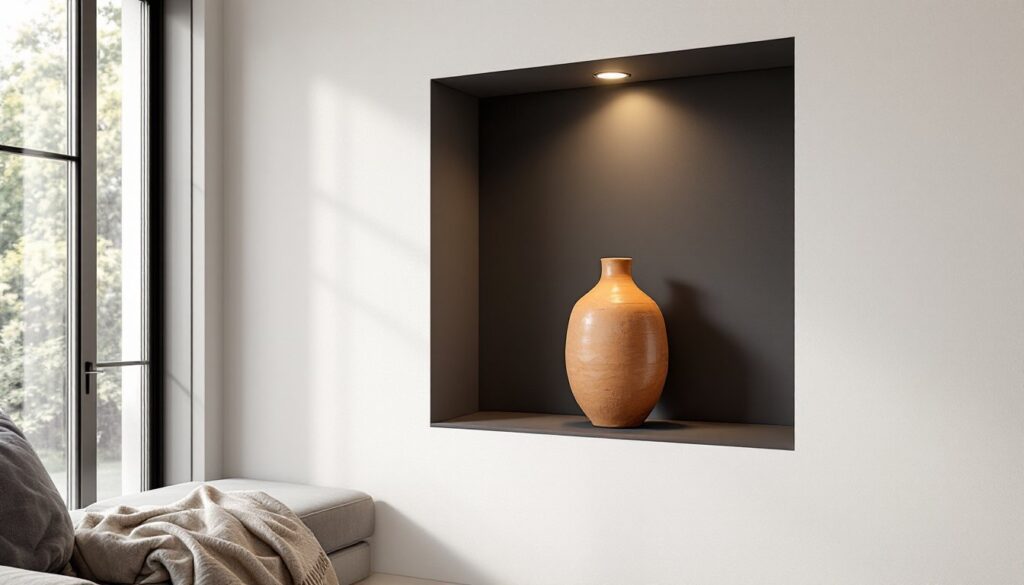
Wall niches often sit empty or get ignored entirely, a missed chance to add character without eating up floor space. These recessed pockets, whether purpose-built during framing or carved out during a remodel, offer unique opportunities to showcase art, hide clutter, or introduce lighting drama. Unlike shelves or furniture, niches feel intentional and architectural. They draw the eye without dominating a room. The trick is treating them as deliberate focal points rather than afterthoughts. With the right combination of objects, lighting, and background treatment, even a modest 16″×16″ cutout between studs can anchor an entire wall.
Key Takeaways
- Wall niche decor ideas transform underused recessed spaces into intentional focal points that add character without consuming floor space, making them ideal for tight hallways, bathrooms, and behind-sofa zones.
- Strategic lighting with recessed LED puck lights and edge-mounted strips elevates niches from dark voids into gallery-like displays, with warm white (2700K–3000K) temperatures creating the most inviting residential effect.
- Accent paint in jewel tones, wallpaper, and material inserts like marble, shiplap, or brushed metal create visual contrast that makes niches pop and prevents them from blending into surrounding walls.
- Display objects that fill 60–75% of the niche height while maintaining breathing room, and rotate seasonal pieces to keep the space dynamic and prevent visual monotony.
- Functional niches in kitchens, bathrooms, and entryways eliminate clutter by providing waterproofed storage for daily essentials, spices, and entryway items without adding furniture footprint.
- Room-specific styling dictates niche content—from curated art displays in living rooms to functional soap storage in powder rooms—ensuring purpose-driven design that respects each space’s context.
What Makes Wall Niches the Perfect Design Opportunity
Wall niches succeed because they work within the architecture rather than against it. Unlike floating shelves that cantilever into a room, niches carve space into the wall, keeping sightlines clean and reducing visual clutter.
From a structural standpoint, most niches fit between standard 16″ on-center studs, giving roughly 14.5″ of usable width (accounting for drywall). Deeper walls, like those around plumbing chases or exterior insulated assemblies, offer more dramatic recesses, sometimes 6″ or more. That depth creates shadow play and allows for layered displays.
Niches also bypass furniture footprint issues. In tight hallways, powder rooms, or behind-the-sofa zones, they add function without blocking traffic. They’re particularly useful in wet areas: a properly waterproofed niche in a shower eliminates the need for hanging caddies or corner shelves that collect soap scum.
Unlike gallery walls that require precise spacing and multiple anchors, a single niche frames itself. The edges provide natural boundaries, making styling more intuitive and less prone to that “something’s off” feeling that plagues open-wall arrangements.
Sculptural and Artistic Display Ideas
Niches thrive when they spotlight a single statement piece rather than crowd with tchotchkes. Sculptural objects, ceramic vessels, abstract wood forms, bronze figurines, gain presence inside a defined frame. The recess acts like a shadow box, lending gallery-level importance to pieces that might read as ordinary on a flat shelf.
Scale matters. An object should fill roughly 60–75% of the niche’s height and width, leaving breathing room without appearing lost. A 12″ tall vase works well in a 16″ niche: a 6″ object will look stranded unless paired with another element.
For art, consider depth. Standard stretched canvas (1.5″ deep) fits most niches, but deeper gallery-wrapped pieces (2″–3″) may require recessing the niche further or floating the canvas on offset brackets. Framed works should sit flush or slightly recessed to avoid protruding past the wall plane, a recessed niche with a proud frame loses its architectural advantage.
Textural contrast amplifies impact. A rough-hewn wood sculpture pops against smooth painted drywall. Glossy ceramics catch light beautifully in a matte niche. Conversely, pairing similar finishes (polished marble in a Venetian plaster niche) creates subtle, high-end cohesion.
Rotating displays keep niches dynamic. Swapping objects seasonally, driftwood in summer, stacked vintage books in fall, prevents the space from becoming invisible through familiarity.
Functional Storage Solutions for Wall Niches
Not every niche needs to be a shrine. In kitchens, mudrooms, and baths, they’re workhorses.
Shower niches are the most common functional application. Standard depth is 3.5″ (between studs), sized to hold shampoo bottles and soap. Tile the interior with the same material as the shower walls for seamless integration, or use contrasting slab marble for a hotel-inspired look. Slope the bottom toward the shower (about 5° pitch) to prevent water pooling. Avoid untreated drywall backing: use cement board or foam backer rated for wet areas.
Kitchen niches near prep zones can corral olive oil, salt cellars, and daily-use spices. Recessed 12″–15″ deep (if wall depth allows), they keep counters clear without adding upper cabinet bulk. Line the back with easy-clean materials: stainless sheet, quartz remnants, or even peel-and-stick metal tile.
In entryways, a niche fitted with hooks or a small charging shelf turns dead wall space into a drop zone for keys, mail, and phones. Add a shallow wood tray or divided insert to keep small items contained, otherwise, niches become catch-all chaos.
Bedroom niches flanking a bed can replace nightstands in tight spaces. Install a small floating shelf or insert at mattress height (typically 24″–28″ off the floor) for a phone, book, and lamp. Route power inside the niche during framing if possible, or use battery-operated LED puck lights to avoid cords.
Lighting Techniques to Enhance Your Wall Niche
Lighting transforms a niche from a hole in the wall to a focal point. Without it, deep niches read as dark voids, especially at night.
Recessed LED puck lights are the go-to solution. Install them at the top of the niche, aimed downward to wash the back wall and contents with even light. Low-voltage (12V) LEDs run cooler and are safer in enclosed spaces than line-voltage fixtures. Use warm white (2700K–3000K) for residential interiors: cooler temps skew clinical.
For drama, add LED strip lighting along the niche’s top or bottom edge. Mount strips on a small L-bracket or cove recessed 1″–2″ from the niche opening to hide the diodes and create a floating glow effect. This works especially well with glass shelves or translucent objects like alabaster.
Battery-powered puck lights offer flexibility in finished walls where running wire isn’t feasible. Modern versions last months on a charge and include remote dimmers. Stick-on options work, but screwed-in fixtures stay put better and look more intentional.
In bathrooms, any niche lighting must meet NEC wet location ratings if it’s within the shower enclosure or within 3′ horizontally and 8′ vertically of a tub. Use IP65-rated or higher fixtures and GFCI-protected circuits.
Color-changing RGB strips are tempting but often read gimmicky. Stick with single-color temperature for a polished result, or use RGB sparingly in media rooms or kids’ spaces where playfulness fits the context.
Color and Material Contrasts That Make Niches Pop
A niche painted the same color as the surrounding wall blends in, sometimes desirable, often dull. Strategic contrast turns it into architecture.
Accent paint is the simplest move. Go two to three shades darker than the wall color for subtle depth, or jump to a saturated jewel tone (navy, forest green, terracotta) for bold impact. The key is painting the entire niche interior, back and sides, to create a cohesive inset, not a patchy afterthought.
Wallpaper or peel-and-stick tile adds pattern without overwhelming a room. A single niche becomes a sample-size test of a bold print. Grasscloth, geometric prints, or metallic textures work well. Trim edges cleanly: sloppy seams ruin the effect.
Material inserts elevate niches to custom territory. Options include:
- Wood paneling or shiplap: Adds warmth and texture, especially in modern farmhouse or Scandinavian schemes. Use 1/4″ plywood or tongue-and-groove boards, finished with matte poly or natural oil.
- Stone or tile: Marble, travertine, or zellige tile introduces luxury. Back-butter tiles fully and use unsanded grout for tight joints in small areas.
- Metal panels: Brushed brass, copper, or blackened steel bring industrial edge. 22-gauge sheet metal cuts with tin snips and adheres with construction adhesive.
- Mirror: Doubles visual depth and reflects light, making small niches feel larger. Use 1/4″ mirror with polished edges, adhered with mirror mastic (not silicone, which can cause edge corrosion).
Whatever material you choose, finish edges neatly. Raw drywall edges look unfinished: wrap them with bullnose tile, wood trim, or metal edge banding for a professional result.
Room-Specific Wall Niche Styling Strategies
Context dictates content. A living room niche and a laundry room niche serve different masters.
Living Rooms: Display curated collections, vintage cameras, ceramics, or a single large art piece. Keep it minimal: overstuffed niches read as clutter. Add a plant for life, but ensure it gets adequate light or use high-quality faux greenery.
Bathrooms: Function first. In powder rooms, style with small succulents, a scented candle, or a single elegant soap dispenser. In master baths, use for daily-use toiletries or rolled hand towels in a spa-like stack. Avoid porous materials that trap moisture.
Kitchens: Showcase cookbooks standing upright, a cutting board collection, or a vintage scale. If near the range, avoid anything that can’t handle heat and grease splatter. Wipeable surfaces (tile, metal, sealed wood) only.
Bedrooms: Flanking niches can mirror each other (matching lamps, books) or play off asymmetry (art on one side, a plant on the other). Above the bed, a single large niche can replace a headboard, styled with textiles or a low-profile sculpture.
Hallways: Prime real estate for art, family photos in matching frames, or a series of small niches stacked vertically to create rhythm. Paint each a different shade in the same color family for a playful, modern look.
Entryways: Keep it practical, a niche with hooks, a bowl for keys, or a small mirror for last-minute checks. This is not the place for fragile decor.
Conclusion
Wall niches punch above their weight, small interventions with outsized impact. They don’t demand much: a thoughtful object, purposeful lighting, maybe a coat of contrasting paint. But they reward that effort by adding dimension and intention to walls that would otherwise sit blank. Treat them as micro-galleries, functional inserts, or architectural punctuation. Just don’t let them sit empty. That’s leaving potential on the table, or in this case, inside the wall.