
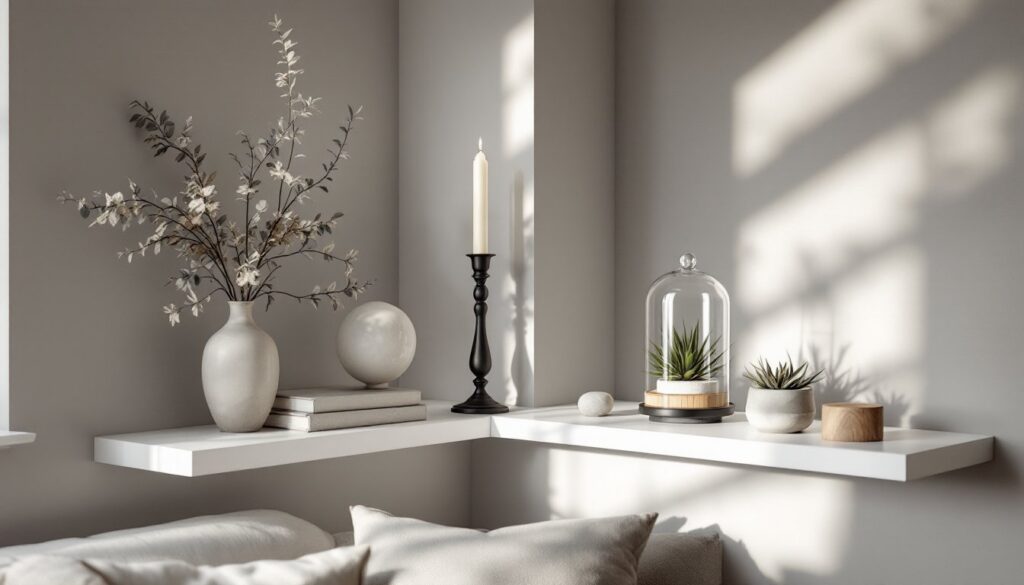
Corner mantels present a unique decorating challenge that most design guides ignore. Unlike their center-wall counterparts, these angular features demand a different approach to scale, sightlines, and symmetry. When done right, a corner mantel becomes a dynamic focal point that pulls together two walls and anchors an entire room. When done wrong, it’s an awkward shelf collecting dust and mismatched candlesticks. The difference comes down to understanding how corners influence visual weight, traffic flow, and perspective. This guide delivers fifteen practical ideas for styling corner mantels across different aesthetics, plus the common mistakes that undermine even well-intentioned arrangements.
Key Takeaways
- Corner mantel decor ideas require asymmetrical balance using triangular composition with the tallest anchor piece at the corner junction and graduated heights toward the outer edges.
- Use the rule of three with odd-numbered groupings on each visible plane, repeating one accent color from the apex to both outer edges to create visual continuity around the angle.
- Maintain 3–4 inches of negative space at the outer ends of each arm and a minimum 6-inch clearance from candles to walls to prevent visual clutter and fire hazards.
- Choose a strong core anchor piece year-round and rotate seasonal accent items around it to avoid complete redesigns and maintain design consistency across fall, winter, spring, and summer arrangements.
- Corner mantels viewed from multiple sight lines benefit from layered textures and depth using three-level stacking: background elements, medium-height objects, and low foreground pieces that create dimension from across the room.
- Avoid common mistakes like ignoring the corner apex, matching both arms exactly, overcrowding shallow 4–6-inch surfaces, and neglecting sightlines from adjacent rooms when styling corner mantels.
Why Corner Mantels Deserve Special Design Attention
Corner mantels operate under different spatial rules than traditional mantels. They’re viewed from multiple angles simultaneously, which means every decorative choice gets scrutinized from at least two vantage points. An object that looks balanced from the living room sofa might appear lopsided from the dining area.
The angular geometry also affects how light hits displayed items. Corner placements typically receive less direct overhead lighting and more cross-lighting from windows or lamps positioned along adjacent walls. This creates shadow patterns that can either enhance dimensional objects or flatten them entirely.
Structurally, corner mantels often cantilever from two walls or sit above angled fireboxes, which limits depth compared to standard mantels. Most corner mantels measure 4-6 inches deep versus the 6-8 inches common on straight installations. That reduced surface area means every inch counts, and oversized decor quickly overwhelms the space.
Traffic patterns matter more with corner mantels, too. They often sit at natural circulation intersections where people move between rooms. Decor that projects too far or sits near edges becomes a hazard. Homeowners need arrangements that look intentional from multiple sight lines while respecting functional clearances.
Creating Visual Balance on Your Corner Mantel
Symmetry works differently on corners. Instead of mirroring left and right, balanced corner displays often use triangular composition, a taller anchor piece near the apex with graduated heights tapering toward the outer edges of each wing.
Effective triangular layering:
- Position the tallest element (a vase, candlestick, or framed art) at the corner intersection, typically 12-18 inches tall for standard 8-foot ceilings
- Step down to medium-height objects (6-10 inches) at the midpoint of each mantel arm
- Finish with low, horizontal elements like stacked books or shallow bowls at the outer ends
The rule of three applies, but with a twist. Group objects in odd numbers along each visible plane, three items on the left-facing section, three on the right-facing section, rather than treating the entire mantel as a single five- or seven-piece arrangement.
Color distribution needs intention. Repeating one accent color at the corner apex and again near both outer edges creates visual continuity that the eye follows naturally around the angle. This technique prevents the “two separate shelves” effect that plagues poorly styled corner mantels.
Negative space becomes an active design element on corners. Leaving the outer 3-4 inches of each arm empty frames the composition and prevents a cluttered, edge-to-edge look. It also maintains safe clearance from combustible materials if the mantel sits above a functional fireplace (most codes require 6 inches minimum from the firebox opening to combustibles, though an engineer’s certification can sometimes reduce this).
Seasonal Corner Mantel Decor Ideas
Fall/Winter arrangements work well with layered textures:
- Flanking the corner with battery-operated taper candles in antique brass or matte black holders (8-12 inches tall)
- Draping a garland along both arms, secured with small finishing nails or removable adhesive hooks
- Clustering pinecones, small pumpkins, or ornament-filled glass cloches at the corner point
- Leaning a wooden bead garland or frosted eucalyptus stem against the back corner for vertical interest
Garland on corners requires more attachment points than straight runs. Plan for anchoring every 10-12 inches to prevent sagging at the angle. Floral wire works better than tape for securing greenery to itself at the corner junction.
Spring/Summer styling benefits from lighter palettes and natural materials:
- A corner-positioned pitcher or ceramic vase with fresh or faux stems (daffodils, tulips, or hydrangeas)
- Stacked vintage books with pastel spines at the outer edges
- A small potted fern or succulent arrangement on a riser
- Coastal elements like coral specimens, driftwood pieces, or hurricane lanterns with pillar candles
Seasonal swaps stay manageable when the core structure remains constant. Keep a neutral anchor piece year-round, a substantial wooden box, a ceramic urn, or architectural salvage like a corbel, and rotate smaller accent items around it. This approach prevents the “complete redesign four times a year” trap that leads to decor burnout.
Minimalist and Modern Corner Mantel Styling
Modern corner mantels thrive on restraint and intentional asymmetry. The goal isn’t balance through mirrored pairs, but through distributed visual weight.
Clean-lined approaches:
- A single large-scale object at the corner: a sculptural vase (12-15 inches), an oversized candle, or a geometric terrarium
- One piece of abstract or black-and-white photography leaning against the wall at the apex
- A low-profile succulent planter (rectangular, 8-10 inches) offset to one arm
- Nothing else
The negative space does the work. Modern styling treats the mantel surface as a canvas where empty areas matter as much as occupied ones. For a corner mantel spanning 48 inches total (24 inches per arm), covering only 12-16 inches with objects creates the right proportion.
Materials should echo the room’s existing finishes. If the space features brushed nickel hardware, incorporate metal accents in similar tones. Rooms with natural oak flooring pair well with ceramic or concrete vessels in warm neutrals.
Monochromatic schemes simplify corner styling. Limiting decor to blacks, whites, and grays eliminates color-balancing concerns and lets form and texture carry the design. A white plaster bust, matte black taper candles, and a gray stone sphere create cohesion through tonal consistency.
For those hesitant to commit to minimalism, the “one statement piece” rule offers a middle ground. Choose a single item that commands attention, a vintage brass telescope, an art glass bowl, a turned-wood candlestick, and let it stand alone at the corner intersection with perhaps one supporting element on the longest arm.
Rustic and Farmhouse Corner Mantel Arrangements
Farmhouse styling leans into collected, layered looks that tell a story. Corner mantels accommodate this aesthetic through curated groupings that avoid the “country craft store explosion” effect.
Foundational farmhouse elements:
- Reclaimed wood signs (8×10 or 12×16 inches) leaned at the corner, layered in front of a larger frame or mirror
- Galvanized metal containers (buckets, pitchers, or canisters) filled with dried cotton stems, wheat bundles, or pussy willows
- Cream or off-white ceramic pieces: ironstone pitchers, stoneware crocks, or pottery bowls
- Woven baskets (small, 6-8 inch diameter) used as risers or grouped for texture
The “found” quality matters in farmhouse decor. Pieces should look collected over time rather than purchased as a set. Mixing finishes, chippy paint, raw wood, aged metal, creates authentic visual interest.
Height variation becomes critical on corners to prevent the flat, spread-out appearance that kills rustic charm. Stack elements: books under a ceramic jug, a small wooden box elevating a candle, a riser beneath a plant.
Layering technique for corner mantels:
- Start with the tallest background element at the corner (framed botanical print, window frame, or wooden cutting board)
- Overlap a medium-height object in front (ceramic pitcher, lantern, or potted herb)
- Finish with a low foreground piece (stacked books, wooden beads, or small crock)
This three-layer depth works on each arm of the corner, creating dimension that photographs well and reads clearly from across the room. Just ensure items don’t cantilever past the mantel edge, most corner mantels won’t support weight distributed beyond their 4-6 inch depth.
Common Corner Mantel Decorating Mistakes to Avoid
Ignoring the corner itself. Many decorators treat corner mantels like two separate shelves, leaving the apex, the most visible point, empty or understated. The corner junction should anchor the entire composition.
Matching both arms exactly. Mirrored symmetry looks forced on corners. The angular geometry demands asymmetrical balance, not identical bookends.
Overcrowding shallow surfaces. Corner mantels have less depth, so every item needs breathing room. Packing a 5-inch-deep surface with decor creates visual chaos and fire hazards if the fireplace is operational. Maintain 3-4 inches clearance from candles to walls or other combustibles.
Using only flat-backed items. Corners beg for objects with interesting profiles when viewed from multiple angles, spheres, cylinders, sculptural forms. Flat frames and signs alone fall flat (literally).
Neglecting scale relative to ceiling height. In rooms with 9- or 10-foot ceilings, 8-inch decor disappears. Conversely, 20-inch candlesticks overwhelm mantels in rooms with standard 8-foot ceilings. A working guideline: the tallest mantel object should measure roughly one-sixth to one-eighth the distance from mantel to ceiling.
Forgetting the view from the adjacent room. Corner mantels are transition points. Walk through connecting doorways and check sightlines from multiple angles. An arrangement that looks balanced from the sofa might block a wall sconce or appear jumbled from the kitchen entry.
Skipping proper anchoring for leaned items. Museum putty, adhesive tabs, or small finishing nails prevent frames and signs from sliding on angled surfaces. This is doubly important near active fireplaces where heat and vibration can shift lightweight decor.
Conclusion
Corner mantels reward thoughtful composition more than their straightforward counterparts. The angular architecture, multiple viewing angles, and reduced depth all demand intentionality, but they also offer the chance to create a focal point that energizes two walls at once. Start with a strong anchor at the corner itself, build asymmetrical balance along each arm, and edit ruthlessly to let individual pieces breathe. Whether the style leans modern, farmhouse, or somewhere in between, the principles remain: respect the geometry, mind the sightlines, and treat empty space as an active design choice.